

Blog
The Basics of Voice Navigation and Conversational UI Explained


Why Your Business Needs Voice Navigation and Conversational UI Now!
Have you ever found yourself talking to your kitchen speaker or asking your car for directions as if it were a friend? If so, you’ve already experienced the magic of Voice-Enabled Navigation and Conversational UI (CUI).
While they might sound like technical jargon, these technologies are designed to make our lives feel less technical and more human. Let’s break down what they are, why they matter, and where you’re likely already using them.
That is a great addition! Adding the "where" helps your readers visualize how they actually use this tech in their daily lives.
I have updated the blog to weave these platforms into the narrative, keeping that humanized, voice-friendly tone.
What is Voice-Enabled Navigation?
Think of voice-enabled navigation as your "digital hands." It’s a tool that lets you control a device using only your voice. Instead of tapping a screen or clicking a mouse, you use spoken commands to get from Point A to Point B—whether that’s on a physical map or inside a mobile app.
The Main Goal: Hands-free efficiency.
The Vibe: "Action-oriented." You give a command, and the machine executes it.
Real-life Example: You’re driving and say, "Hey Google, find the fastest route to the airport." That’s voice navigation in its purest form.
Key Differences at a Glance
| Feature | Voice-Enabled Navigation | Conversational UI |
| Primary Goal | Executing a specific task hands-free. | Simulating a natural human interaction. |
| Complexity | Usually, simple command-response pairs. | Multi-turn dialogues with context.11 |
| Medium | Strictly Voice. | Voice or Text (Chat).12 |
| User Logic | "I say X, the machine does Y." | "I talk to the system like a person." |
Where Do We Use Voice Search Today?
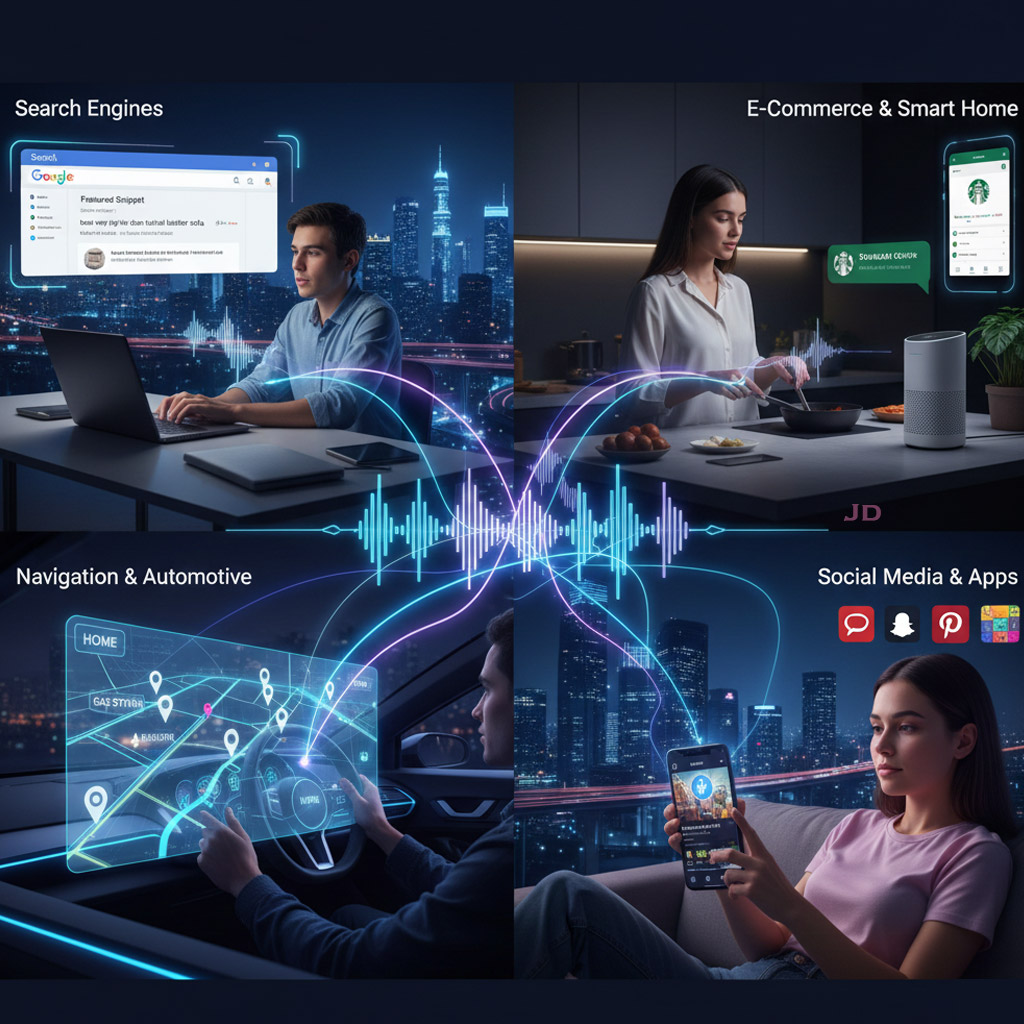
Voice search isn't just for one app; it’s a layer that sits on top of almost everything we do online. Here is where you’re likely to encounter it:
Search Engines (The Knowledge Hubs): This is where we ask Google or Bing those "how-to" questions while our hands are busy cooking or working.
Social Media: On platforms like YouTube or TikTok, people use voice to find tutorials or specific creators instantly.
E-Commerce & Retail: Apps like Amazon or Starbucks let you search for products or even order your morning coffee entirely by talking to your phone.
Navigation & Maps: This is the most common home for voice, through platforms like Google Maps or Apple CarPlay, keeping us safe and focused on the road.
Smart Devices: Your Smart TV remote or your Alexa/Google Home speakers act as the gateways, connecting your voice to the entire internet.
Summary Table on Platforms
If you want to include a quick reference in your blog, this table works well:
| Platform Type | Primary Use Case | Example |
| Search Engines | Information & Facts | Google Voice Search, Bing |
| E-Commerce | Quick Purchases | Amazon, Starbucks App |
| Navigation | Local Discovery | Google Maps, Waze |
| Social Media | Entertainment/Filters | TikTok, Snapchat, YouTube |
| Smart Home | Utilities & Control | Alexa, Apple HomePod |

Why Do We Need Them Together?
When we combine navigation and conversation, we get an "Invisible Interface." The technology disappears, and the experience takes center stage.
1. It’s Faster
Most of us can speak at a rate of about 150 words per minute, but we type at a rate of only about 40. Voice tech lets us bypass menus and buttons to get exactly what we need instantly.
2. It’s Inclusive
For people with visual impairments or motor disabilities, voice-first design isn't just a "cool feature"—it’s a bridge to independence.
3. It Feels Human
We are biologically "wired" for conversation. Talking to a system that responds with empathy and clarity reduces the "tech-stress" we often feel when a screen is too cluttered.
Frequently Asked Questions (The Voice Search "Cheat Sheet")
Is voice navigation the same as a chatbot?
Not exactly. A chatbot is a type of Conversational UI (usually text-based), while voice navigation is a specific function that allows you to move through an app or a physical space using sound.
Can I use voice navigation on my website?
Yes! Many modern websites are incorporating voice search to assist users in finding products or information without having to scroll through lengthy, confusing menus.
Why is voice search important for my business in 2026?
Voice search is growing fast because users want quick, natural answers. Optimising for voice helps your business appear in spoken queries, AI summaries, and featured results — giving you more visibility beyond traditional search rankings.
Do I need a special website to support voice search?
Not necessarily. Most websites can be optimised for voice search by improving page speed, mobile usability, structured data, and by writing content that answers real questions clearly and naturally.
How do I optimise my website for voice search?
Start by focusing on natural-language keywords, FAQ sections, fast loading speeds, mobile optimisation, and structured schema markup. Voice search works best when your content directly answers the kinds of questions people actually speak aloud.
Does voice search affect SEO rankings?
Yes — indirectly. Voice search favours websites that are well-structured, fast, mobile-friendly, and authoritative. Sites that already follow strong SEO best practices are more likely to be selected for voice answers and AI-generated results.
Are people in South Africa really using voice search?
Absolutely. With the widespread use of smartphones and voice assistants, more South Africans are using voice search for directions, local services, and quick answers. This trend is expected to grow significantly through 2026 and beyond.
What types of businesses benefit most from voice search?
Local service businesses, eCommerce stores, tourism companies, and professional services benefit greatly. Any business that relies on “near me” searches or quick customer questions should be preparing for voice-driven discovery.
Is voice search only for Google and smart speakers?
No. Voice interaction is expanding across mobile apps, in-car systems, websites, AI assistants, and even customer support platforms. It’s part of a broader shift toward conversational digital experiences.
What is the first step to becoming voice-search ready?
The best first step is a professional SEO and website audit to identify technical gaps, content opportunities, and quick wins that can improve your visibility in both traditional and AI-driven search.
The Bottom Line
The future of technology isn't more screens—it’s fewer screens and more meaningful conversations. By understanding the basics of voice navigation and CUI, you’re looking at a world where technology finally learns to speak our language.
Would you like me to write a few "Social Media Teasers" (for LinkedIn or Instagram) to help you promote this new blog post once it's live?