

Blog
Zombie Virus – A 24-Hour Recovery of a Major Travel Magazine

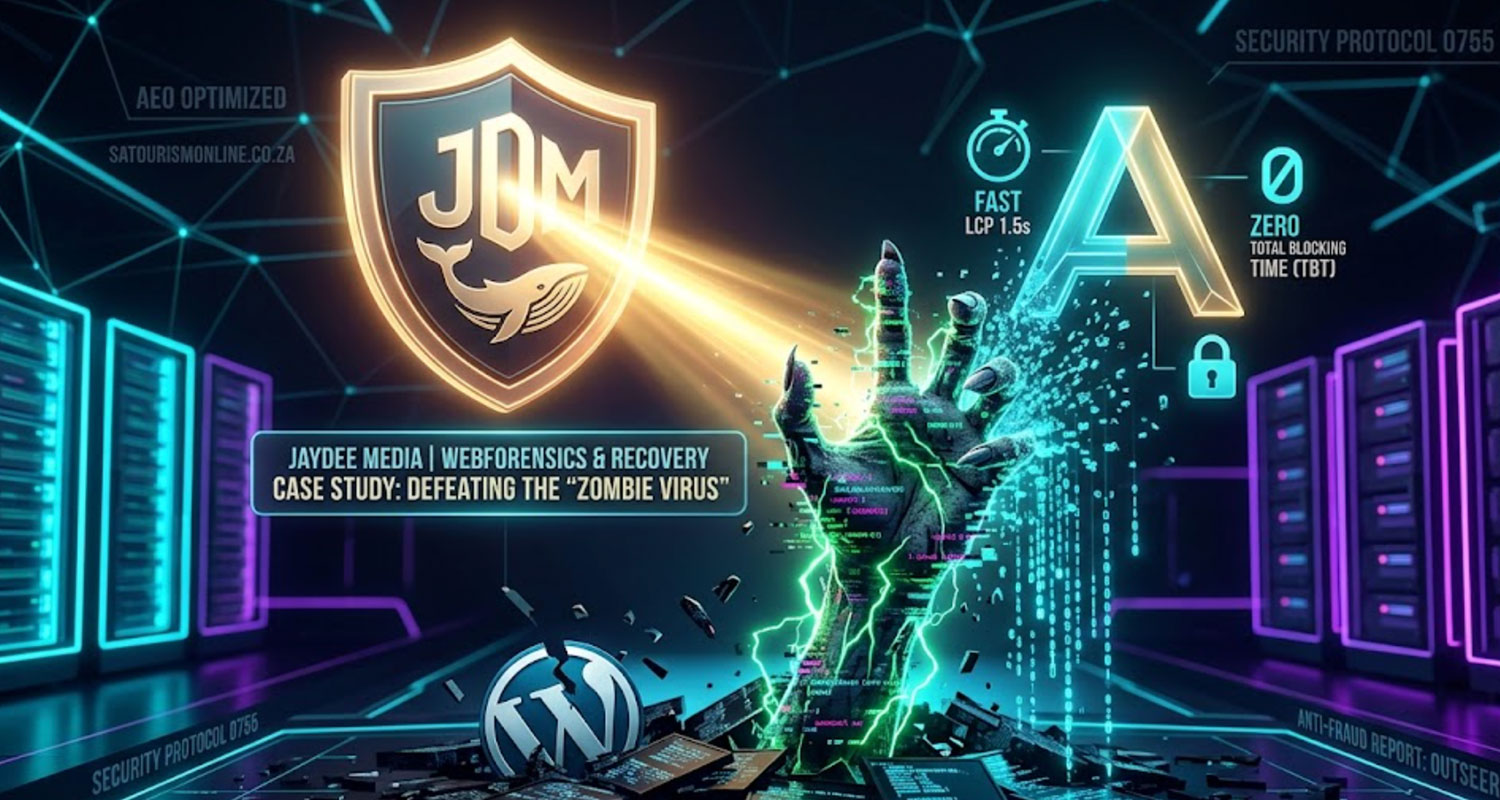
The Anatomy of a Phishing Hack: How We Recovered and Optimized in 24 Hours
In the digital world, some threats don’t just stay dead. At Jaydee Media, we recently handled a high-stakes security recovery for a prominent online Travel Magazine that had been targeted by a sophisticated phishing campaign.
This wasn’t a standard "change your password" fix. We were dealing with what we call a "Zombie Virus"—malware specifically designed to resurrect itself even after the primary files are deleted.
The Challenge: A Sophisticated Phishing Attack
The site was flagged by the Anti-Fraud Command Center (Outseer) for hosting a phishing kit disguised as a banking login page. The attackers hadn’t just uploaded a few bad files; they had integrated themselves into the core of the site, creating a malicious "staging" environment and several "backdoors" to ensure they could get back in if caught.
The Forensic Audit: Identifying "Patient Zero"
Our investigation pinpointed the entry point: a compromised version of a popular social media automation plugin. Because this same vulnerability had appeared in a previous "Zombie" incident on another booking platform, we were able to quickly identify the common denominator.
Key findings during our audit included:
Unauthorized Backdoors: Files named
mu.phpandwp-compat.phpwere hidden in system directories.Open Gates: The attackers had changed specific folder permissions (like
.tmbdirectories) to 0777 (World Writable), allowing them to drop new phishing kits onto the server at will.Persistent Access: Malicious "Must-Use" plugins were set up to execute code every time a page loaded, independent of the standard plugin list.
The Jaydee Media Recovery Strategy
We didn't just "clean" the site; we hardened it. Our recovery process followed a strict technical protocol to ensure the "Zombie" could not return:
Software Vaccination: We completely purged the vulnerable plugin and replaced it with a verified, licensed version.
Infrastructure Lockdown: We performed a "triple-reset"—rotating the WordPress Authentication Salts, changing the Database Passwords, and updating all administrative credentials.
Permission Correction: We manually audited the server via cPanel to reset directory permissions to secure standards (0755), closing the "drop zones" used by the hackers.
Performance Optimization: During the cleanup, we identified and removed redundant "bloat" plugins (overlapping SEO and caching tools) that were slowing down the site.
The Result: Faster, Leaner, and Fully Secure
The recovery didn't just restore the site; it improved it.
Security Clearance: We provided a comprehensive resolution report to the Anti-Fraud Command Center, ensuring the domain was whitelisted and protected from browser blacklisting.
Performance Boost: By streamlining the backend, we achieved an excellent 1.5s Largest Contentful Paint (LCP), placing the site in the top tier of performance for user experience.
Zero Recurrence: Thanks to the salt rotation and database lockdown, the "Zombie" scripts were successfully neutralized.
The Lesson for 2026: Technical Trust is Key
As we move toward Answer Engine Optimization (AEO) and AI-driven search, security is no longer "optional." Search engines prioritize sites that are safe, fast, and authoritative.
At Jaydee Media, we don't just build websites; we protect digital assets. This case study proves that even the most persistent "Zombie" threats are no match for a methodical, technical approach to security.
Is your website truly secure? Don't wait for a report from a fraud center. Contact Jaydee Media today for a Security & Performance Audit.